AI never owns the books
Models propose classification and extraction; deterministic services preserve accounting invariants.
An AI bookkeeper built on a real double-entry accounting engine
A full-stack financial operating system for small service businesses. The product hides accounting vocabulary behind a review inbox while preserving ledger integrity underneath—combining invoicing, expenses, reconciliation, receipts, tax workflows, and an assistant that can answer questions over the books.
Role · Product architecture and full-stack engineering
System anatomy
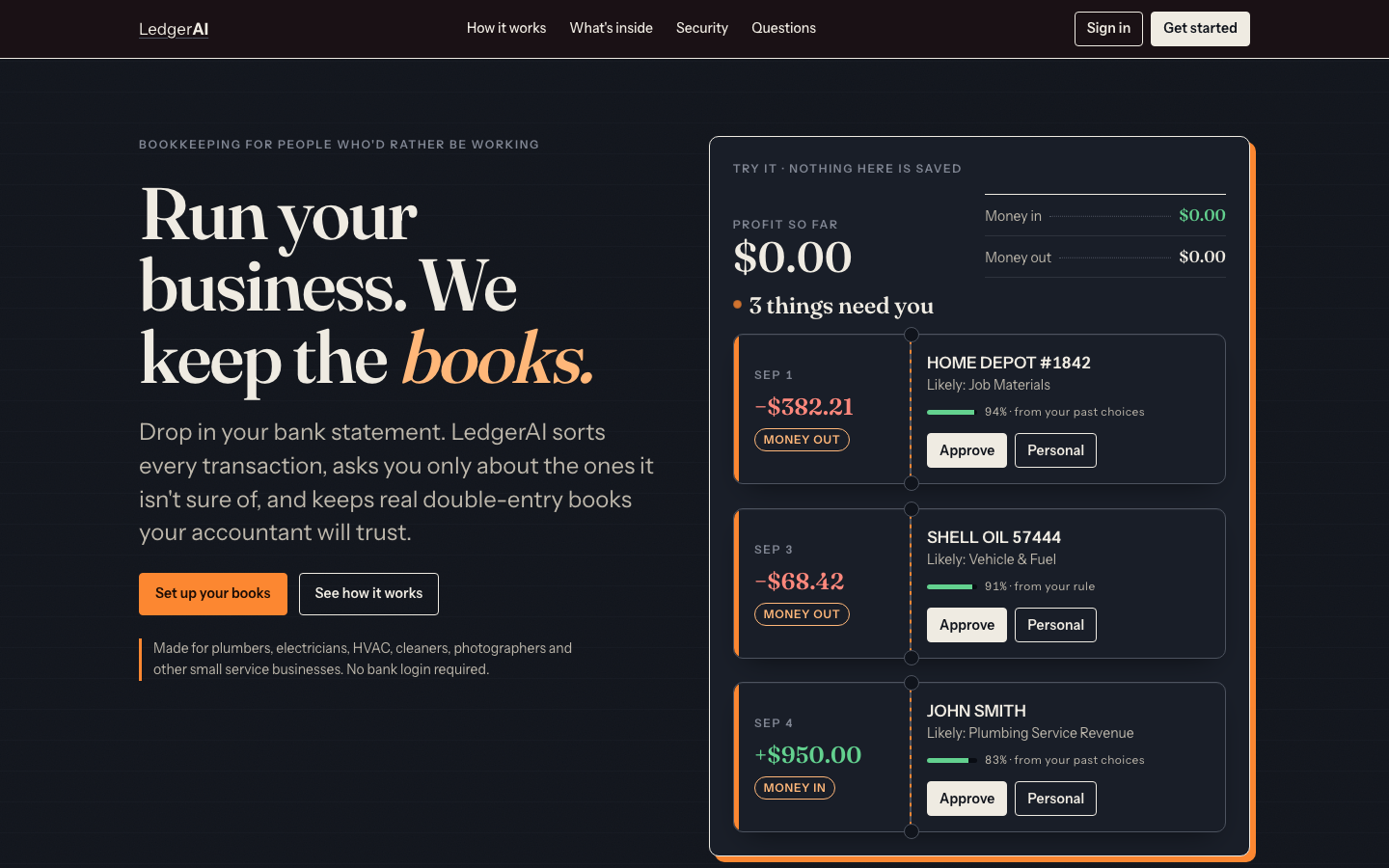
Captured from the live product · October 2026
Open live productThe problem
Small-business owners need reliable books without learning chart-of-accounts mechanics. LedgerAI turns financial activity into reviewable decisions while keeping every accepted action consistent with a double-entry ledger and audit trail.
What the system does
Double-entry ledger with cash/accrual reporting and integrity checks
Invoices, estimates, bills, expenses, payments, credit notes, and recurring work
CSV/PDF statement import, receipt photo extraction, matching, and reconciliation
Rules and learned merchant memory with guarded AI categorization
Ask-your-books assistant, insights, tax center, and accountant export package
Tenant isolation, team roles, audit, recovery, MFA, and passkey authentication
Architecture
FastAPI domain services around ledger, matching, receipts, tax, and reporting
PostgreSQL as the source of truth with transactional background-job queue
S3-compatible document storage for receipts and statements
Next.js 16 responsive PWA with extensive accessibility and e2e coverage
Provider gateway keeps LLMs limited to extraction and understanding—not money math
Key decisions
Models propose classification and extraction; deterministic services preserve accounting invariants.
Owners work through exceptions and decisions while journal mechanics remain underneath.
Posted financial history is preserved through reverse-and-repost workflows instead of silent mutation.